

Understanding Order Flow And How It Relates To Trading Servers
If we strip away the buzzwords, order flow is just the raw heartbeat of the market: who’s lifting the offer, who’s hitting the bid, where liquidity is stacked, and where it suddenly disappears. The catch? That heartbeat is incredibly fast and incredibly fragile. We can stare at a DOM ladder, a footprint chart, or a Bookmap bubble all day, but if our trading server is late, overloaded, or dropping packets, the “order flow” we’re seeing is already history. In a game where a two‑tick fade or a 300‑microsecond fill can define your month, the infrastructure under your charts matters as much as the strategy on top of them. In this guide, we’ll unpack what order flow really is, why it’s so sensitive to speed and stability, how a trading server actually “sees” it, and how to align your hardware, platform, and network with the style of order flow trading you’re running, from footprint-driven scalping to GPU‑heavy visualization and HFT‑style automation.What Order Flow Really Is (Beyond Just Volume)
When most traders first hear “order flow,” they think volume bars. But volume is the after‑the‑fact summary: order flow is the play‑by‑play. Order flow is the sequence and structure of:- Limit orders resting in the book (liquidity providers)
- Market orders consuming that liquidity (aggressors)
- Cancellations and modifications reshaping that liquidity in real time
- Who is in control: bid or offer?
- Liquidity vs. traded volume
- The sequence of events
Why Order Flow Is So Sensitive To Speed And Stability
Order flow trading is less about being smart and more about being current. If we’re making decisions on:- Which side is absorbing
- Where spoofing or pull‑and‑stack behavior appears
- Whether a breakout is driven by genuine aggression or thin liquidity
- Delayed view of the book
- Micro‑gaps in the feed
- Desync between chart and order routing
- Consistently low latency (1–10 ms to the broker or exchange gateway when possible)
- Stability under load (no CPU spikes, no swapping to disk, no network congestion)
- Predictability (jitter often hurts more than a slightly higher but stable baseline)
How Your Trading Server Actually Sees Order Flow
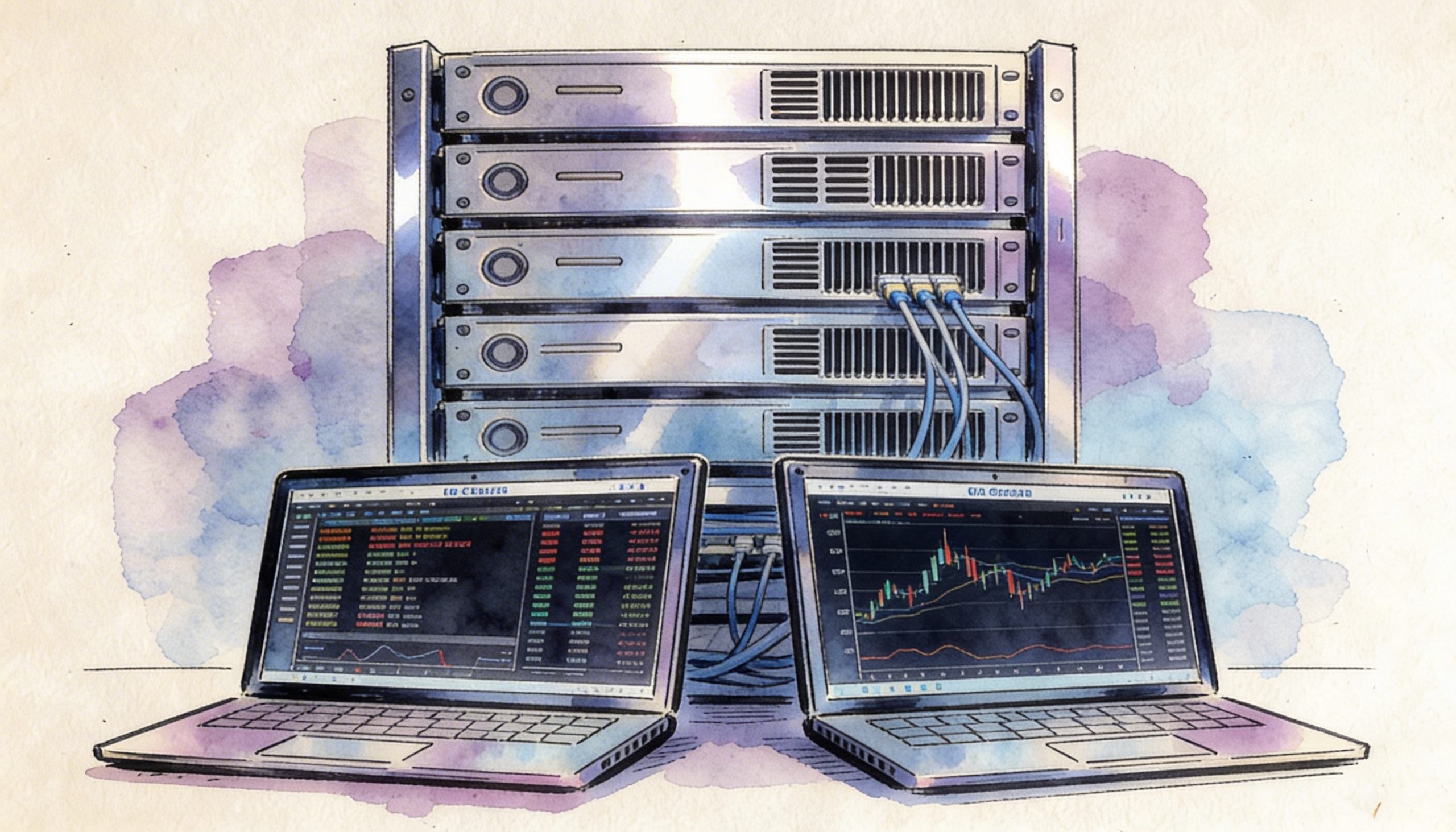
Let’s demystify what’s actually happening under the hood when we open NinjaTrader, Bookmap, or another order flow platform on a trading VPS.- Exchange → Data Vendor / Broker
- Data Feed → Our Trading Server
- Platform → Order Book Reconstruction
- Apply add/cancel/modify messages in the right order
- Calculate best bid/offer, depth, and derived metrics
- Feed that into DOM ladders, footprints, and heatmaps
- Visual Rendering
- Server → Exchange (Our Orders)
- CPU pinned at 100%: delayed book reconstruction, laggy DOM, stale prints.
- Insufficient RAM: paging to disk during high‑volatility bursts: platforms freeze or stutter.
- Slow storage: massive historical tick or footprint databases cause pauses and UI hiccups.
- No GPU headroom: heatmaps and multi‑monitor layouts feel choppy or lag behind.
Key Server Specs That Matter For Order Flow Trading
Order flow doesn’t need a supercomputer, but it does need the right kind of power. Some specs matter a lot: others look flashy on paper but barely move the needle.CPU Power: Single‑Threaded Speed For DOM, Footprints, And Heatmaps
Most trading platforms are still heavily single‑threaded for core tasks: DOM updates, main chart processing, and some parts of backtesting. That means raw GHz and IPC (instructions per clock) on a few cores often beats having 48 sleepy cores. That’s why we favor high‑performance chips like Ryzen 7950X and Ryzen 7/8xxx on our Alpha‑series VPS and Delta dedicated servers:- Top‑tier single‑thread Passmark scores
- High boost clocks (5+ GHz) under bursty trading loads
- Plenty of cores left over for background tasks and algos
RAM, Storage, And GPU: Keeping Order Flow Visuals Instant
- RAM (Memory)
- 8–16 GB for light discretionary order flow
- 16–32 GB+ for multi‑asset, multi‑monitor, and heavy tick recording
- Storage
- GPU
- Run Bookmap‑style heatmaps all day
- Use GPU‑accelerated analytics or ML on live order flow
- Drive multiple high‑resolution monitors via remote protocols
Latency And Routing: From Your Charts To The Matching Engine
Even the best hardware stumbles if the network path is bad. Key points we optimize for in our trading VPS locations:- Physical proximity to major futures and FX venues (CME, NY4/LD4, etc.)
- BGP‑optimized routes and blended IP transit for lower hop counts and better resilience
- 1 Gbps+ uplinks with DDoS protection and smart filtering
- 0–1 ms from VPS to certain broker gateways in the same data center
- 1–10 ms to clustered venues for most active US futures
Tuning Your Setup For Order Flow: Platform, Feeds, And Network
Hardware is half the story. How we configure our stack matters just as much.1. Choose The Right Platform And Plug‑Ins
If order flow is our main edge, we want platforms that expose it clearly:- NinjaTrader with order flow + footprint/volume profile add‑ons
- Bookmap or similar heatmap‑style tools
- Sierra Chart / ATAS / Quantower with depth and footprint modules
- Thread affinity (which cores the platform prefers)
- Data buffer sizes and history length
- Chart update intervals vs CPU usage
2. Use A Quality Data Feed
Even the best trading server can’t fix a poor data source. For serious order flow:- Favor low‑latency, unfiltered tick feeds from reputable vendors or direct broker connections.
- Avoid over‑compressing or aggregating ticks. Time‑based aggregation can blur the microstructure we’re trying to read.
3. Optimize Network And Remote Access
A few simple network best practices go a long way:- Pick a VPS data center closest to your broker or exchange gateway.
- Use a stable, wired connection from your home/office to the VPS (remote desktop): Wi‑Fi spikes can create false impressions of “platform lag.”
- Prefer efficient remote protocols (e.g., RDP, optimized VNC) with reasonable color depth and compression.
- Latency tests from our trading VPS to your broker’s servers
- Adjusting MTU/stack settings where appropriate
- Monitoring CPU/memory/network usage in real time so you know what’s actually causing slowdowns
Matching Different Order Flow Styles To The Right Server
Not all order flow traders stress their infrastructure the same way. We can usually bucket needs into a few patterns.Scalping, HFT‑Style Automation, And Heavy Visualization Workloads
Profile:- DOM scalping on ES/NQ/CL
- Multiple footprint charts and heatmaps
- Maybe an automated layer (bracket logic, entry/exit algos, or full HFT‑style strategies)
- Top‑tier single‑thread CPU (Ryzen 7950X‑class)
- 16–32 GB RAM for multiple instruments and tick storage
- NVMe SSD for nonstop tick writes
- GPU support if you’re running dense heatmaps or multi‑monitor setups
- Data center close to the matching engine for 1–5 ms round‑trips
Discretionary Order Flow Trading On A Budget‑Conscious Setup
Profile:- 1–3 instruments
- A few DOMs, some simple footprints, limited heatmap usage
- Primarily discretionary: minimal automation
- Solid but not extreme CPU (still with decent single‑thread performance)
- 8–16 GB RAM
- Reliable NVMe storage
- Reasonable latency (10–20 ms may be acceptable if we’re not tick‑sniping)
Conclusion
Order flow is the closest we get to reading the market’s intentions in real time. But it only works if what we’re seeing is both accurate and current. That’s where trading servers, the hardware, storage, and network stack under our charts, quietly make or break our edge.Limitations Of Retail Infrastructure Vs. Institutional Stacks
Institutional desks sit a few fiber jumps away from matching engines, with custom hardware, dedicated lines, and full‑time network engineers. Retail traders at home are often:- 30–80 ms away from the exchange
- Sharing broadband with streaming, gaming, and IoT devices
- Running trading platforms on multitasking home PCs
CPU Power: Single‑Threaded Speed For DOM, Footprints, And Heatmaps
Order flow tools are chatty. DOM ladders, footprint recalcs, and real‑time delta all hit the CPU constantly. By running on high‑clock, high‑IPC CPUs like our Ryzen 7950X/7/8xxx stack, we:- Reduce UI lag and DOM “stickiness” during volatility bursts
- Keep book reconstruction and chart updates in sync with the live tape
- Leave headroom for algos and background tasks
RAM, Storage, And GPU: Keeping Order Flow Visuals Instant
RAM, NVMe, and GPU form the support cast:- Enough RAM means no mid‑session swapping when tick volume spikes.
- NVMe SSDs keep historical loads, tick databases, and logs from freezing our platform.
- GPU resources keep heatmaps, footprint grids, and multi‑monitor setups smooth instead of choppy.
Latency And Routing: From Your Charts To The Matching Engine
Once our local environment is fast, the remaining edge is in distance and routing:- Hosting close to broker/exchange gateways
- Smart, BGP‑optimized paths and resilient blended transit
- 0–1 ms to certain gateways: low‑single‑digit ms to major venues where possible
Scalping, HFT‑Style Automation, And Heavy Visualization Workloads
For the most demanding use cases, DOM scalping, semi‑HFT automation, dense heatmaps, we lean into:- Top 1% single‑thread CPUs
- Generous RAM and NVMe storage
- Optional GPU VPS tiers for visualization
- Dedicated servers when isolation and maximum consistency are mandatory
Discretionary Order Flow Trading On A Budget‑Conscious Setup
If we’re primarily discretionary and still building our playbook, we don’t need to overspend. A well‑spec’d trading VPS with:- Modern, high‑clock CPU
- 8–16 GB RAM
- NVMe storage
- Decent proximity to our broker
Order flow is a precision tool. To get the most from it, we pair the right platform and feed with a server stack that’s built for trading, low‑latency network paths, high single‑thread performance, fast storage, and enough headroom for the way we actually trade. If you’re not sure what kind of trading server your order flow style really needs, give us a shout. We’re happy to look at your current setup, your platform mix, and your markets, and help you choose or customize a ChartVPS plan that lets your infrastructure finally keep up with your edge.