

One entry. Five accounts. Three different fill prices.
You check the copier. Everyone is connected. The quantities look right. The VPS has a reassuringly low ping. So why did the same trade come back with different numbers?
Because the trading decision was shared. The executions were not.
Each follower account needs its own order processed and filled. The copier’s settings, the machine running it, the route to the broker, and the available liquidity all have a say in what happens next. A faster connection can remove a real delay without making five separate orders into one transaction.
For traders running NinjaTrader across personal or prop accounts, that distinction is worth getting straight. Otherwise, a missed fill becomes a hosting complaint, a CPU bottleneck gets mistaken for slippage, and a setting change solves a different problem from the one you have.
Let’s follow the trade.
What Does Your Copier Copy?
It sounds like a silly question until you discover two accounts are following different instructions.
Order copying sends a corresponding order to the follower. If the leader submits a limit order, the follower can have its own limit order working before either account fills. Replikanto uses order copying by default, including entries and exits.1
Execution copying waits for a fill on the leader, then acts on that fill. Replikanto calls this Market Only: a leader execution triggers a follower market order. A working leader limit order does not become a working follower limit order in this mode.2
That changes the starting point. In one workflow, both accounts can be waiting at their limit prices. In the other, the leader has already traded before the follower’s new market order is submitted.

There is an important protection detail here. In Market Only, Replikanto does not copy the leader’s resting stop or profit-target orders onto the follower. It responds when the leader’s exit executes. You therefore need to understand what protection exists on each account and what happens if the copying path is interrupted.2 A checkbox that sounds like an entry preference can change the exit dependency too.
ATM Copy is another distinction. With an applicable NinjaTrader ATM entry, the follower’s own ATM strategy manages its exits rather than receiving copied leader exits.1 Check the follower’s template and settings; a familiar strategy name is not a substitute for inspecting them.
None of this is a recommendation to switch modes during a session. Establish which event triggers your follower orders first. Then test whether that behaviour suits the way you trade.
The first timing question is not how fast the copier runs. It is what the copier waits for.
There Is Only So Much at That Price
Imagine a simplified live order book with three contracts offered at the best ask. The leader buys two. Before more sell orders arrive at that price, a follower tries to buy another two.
Only one of the original three remains. The follower may need liquidity at a higher price for the rest. Nothing has to crash, disconnect or malfunction for the average prices to differ.
This is a hypothetical snapshot, not a prediction. Real books change while messages are moving, and other participants are trading too. The useful point is that copying adds orders; it does not duplicate the liquidity available to the leader.
Resting limit orders introduce a different problem: priority. Under a first-in, first-out matching algorithm, earlier orders at the same price have priority. A follower joining later does not inherit the leader’s place. CME documents several matching algorithms, so the exact allocation rules depend on the product.3
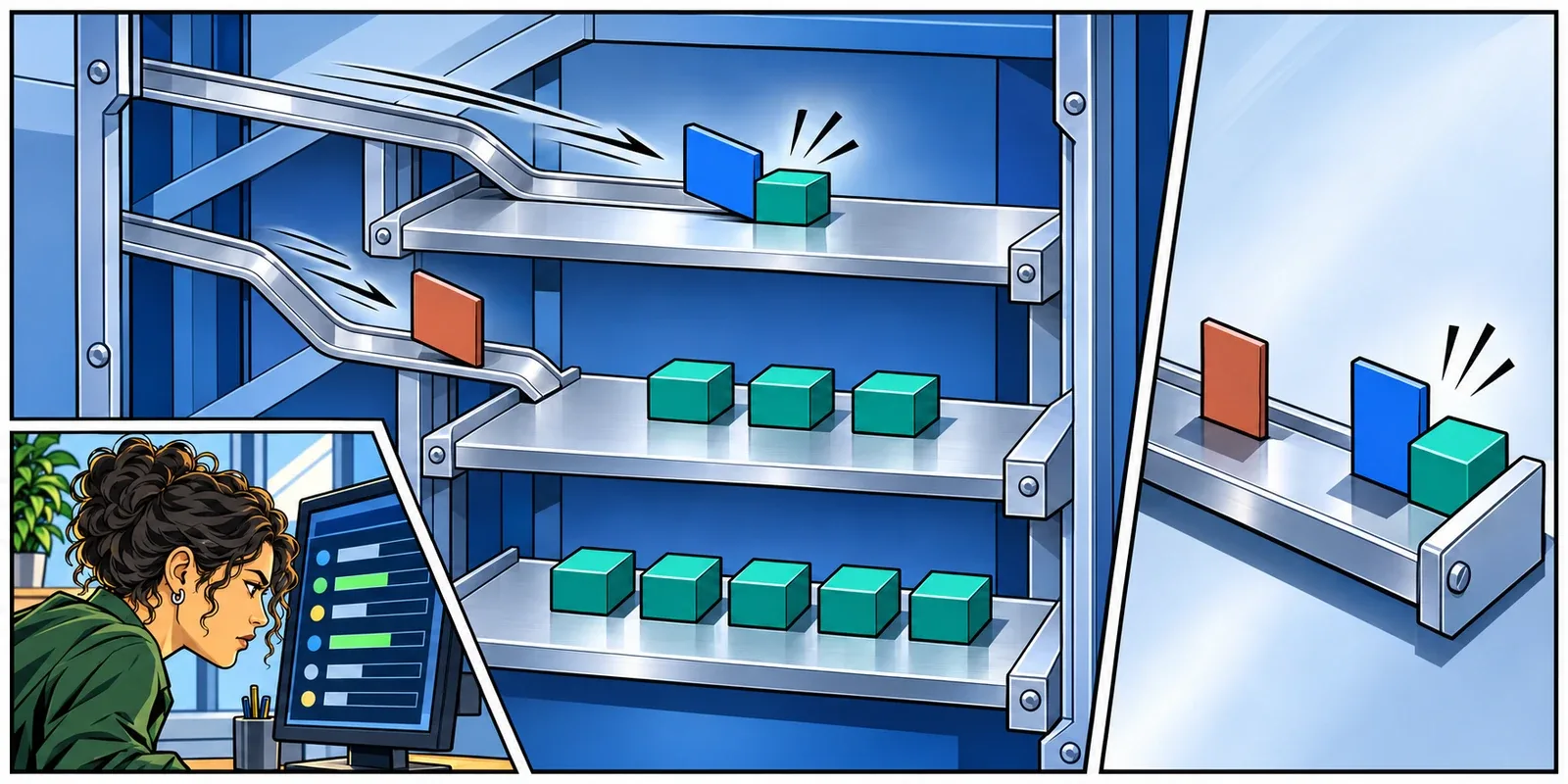
A chart touching your limit price is not evidence that enough volume traded through the queue to fill every follower. Equally, an order remaining unfilled is not proof it arrived late. Check whether it was submitted, accepted and left working before diagnosing the network.
There is another distinction for prop-account setups: is this account’s execution simulated or live? A simulation fill is not an exchange fill with a different label. NinjaTrader’s simulator models factors such as volume, queue position and delays.4 It does not give the follower a reserved place in a live order book. Record the execution environment for each account when comparing results.
You can copy an order. You cannot copy its place in the queue.
Follow the Instruction, Not Just the Ping
For copying between hosted machines, trace four stages:
- Leader processing: NinjaTrader and the copier observe the event that should trigger a copy.
- Copy delivery: the instruction reaches the receiving copier on the follower machine.
- Follower submission: the receiving platform processes it and submits the follower order through its broker connection.
- Execution: account checks, routing and market matching determine what happens to that order. A simulated account instead goes through its execution service or simulator.
A ping between two VPS nodes measures a network round trip.5 It does not time that entire sequence. A fill report returning to your screen adds another part of the journey.
The Platform Still Has Work to Do
The copier is software running inside a busy trading environment. Receiving a message and acting on it are separate jobs.
FlowBots documents a revealing distinction: Replikanto dispatches to remote nodes in parallel, while regular copying to local follower accounts, including ATM copies, uses NinjaTrader’s user-interface thread for successive submissions. Local Market Only copies and follower-position closes have a parallel path.6
So “all on the same machine” does not mean zero processing delay. Nor does parallel dispatch mean every account completes at the same instant.
CPU speed, available processing capacity and account count belong in the diagnosis. NinjaTrader also identifies workspace complexity and third-party scripts as performance factors.7 Test with the charts, feeds and indicators you use during trading, not an empty desktop that looks excellent at midnight.
A practical arrangement is to keep execution and copying separate from heavy backtesting or optimization. That can mean a leaner workspace or a separate server when the workload warrants one. Buying more resources is useful when resources are the constraint; first establish where the waiting happens.
A Shorter Copy Path Is a Real Improvement
If the leader and follower run on different machines, the instruction needs a route between them. Every additional public-network dependency gives you another route to provision, observe and troubleshoot.

At ChartVPS, TradeCopy connects NinjaTrader and Replikanto nodes through a private network between hosted servers. We publish typical 0-1ms copy-path latency between those nodes.8 Read that as a claim about the private network segment, not the elapsed time from a leader fill to a follower fill.
That architecture keeps the copying path off public internet routes between the nodes and lets us investigate the hosting and network layers together. The platform still needs CPU time, and each broker connection still has work downstream. A well-chosen hosting setup improves the parts you can control rather than promising identical market outcomes.
A good network delivers the instruction sooner. The receiving platform still has to act on it.
One Tick Across Five Accounts
A tick can look small on one execution line. Across a copying setup, it deserves its own calculation.
For outright futures, one MES tick is 0.25 index points, worth $1.25 per contract. One ES tick is also 0.25 points, but worth $12.50 per contract.9
Suppose five follower accounts each trade two contracts. On one completed long trade, every follower buys one tick higher than the leader and sells one tick lower. That is two adverse ticks per contract across the round trip.
| Hypothetical Comparison | Two MES per Follower | Two ES per Follower |
|---|---|---|
| Difference at entry, per follower | $2.50 | $25.00 |
| Difference at exit, per follower | $2.50 | $25.00 |
| Round-trip difference, per follower | $5.00 | $50.00 |
| Total across five followers | $25.00 | $250.00 |
The calculation is 2 adverse ticks x tick value x 2 contracts x 5 followers. It excludes commissions and assumes all accounts complete the same quantities. These are illustrative price differences, not typical slippage figures or savings a VPS upgrade promises.
Followers can also receive better prices. Keep favourable and adverse differences in the records rather than remembering only the annoying ones. Compare buys and sells in the correct direction: a higher buy is worse; a higher sell is better.
For partial fills, use quantity-weighted average prices for the matched quantities. Comparing the leader’s first fill with the follower’s whole-order average can manufacture a discrepancy that is partly a reporting choice.
And keep commissions separate. An account’s net P&L is not a clean measurement of execution quality if its fees or contract quantities differ.
Measure the difference in ticks first. Then multiply it by the exposure you are copying.
Different Price or Different Position?
These deserve separate investigations.
Two accounts holding the intended quantity at slightly different prices have an execution-price difference. A follower still holding contracts after the leader has exited has a position mismatch. Faster copying alone does not resolve an already-open, unaccounted-for position.
FlowBots lists unfilled limits, partial fills, offline follower machines and exit-management problems among the causes of accounts falling out of sync.10 Read the order state and rejection message before putting every discrepancy in the slippage bucket.
Sizing settings matter too. An intended ratio can make different quantities correct. Compare the follower against its configured allocation, not automatically against the leader’s raw contract count.
Copying ES into MES, or NQ into MNQ, adds another variable. Related contracts have distinct order books. FlowBots notes that cross-instrument copying can produce a fill on one instrument without a corresponding fill on the other.1 Matching index exposure does not give two instruments shared liquidity.
For each follower, establish the intended instrument and contract month, quantity rule, entry mode, exit-management method, and whether the account is permitted to copy under its provider’s rules. Keep that small configuration record alongside your execution records. It makes a surprising outcome much easier to explain.
If exposure is uncertain now, use the broker’s account records and documented recovery process, or contact its trading desk. Diagnose the copying setup after the live account picture is clear. A second order is not a harmless way to test whether the first one arrived.
A price difference changes the result of a trade. A position mismatch can mean you are still in one.
Trace One Trade Before Changing the Setup
Pick a specific event with a clear discrepancy. You want its records, not a general impression that the followers feel slow.
NinjaTrader’s Orders tab includes order type, state, filled and remaining quantity, average price and account. Its Executions tab includes individual fill quantity, price, time, execution ID, order ID and connection. Both support exporting their grids.1112
Start with those records, the copier log, and the platform log. Keep the platform and copier versions with the incident.
| What the Records Show | What to Investigate Next |
|---|---|
| No corresponding follower submission | Trigger mode, account selection, copier state, local processing or copy delivery. Absence from one log is not proof the broker received nothing. |
| Follower order rejected | The actual rejection reason, account limits, quantity and instrument settings. |
| Order accepted but still working | Order type, price, available liquidity and matching priority. |
| Filled quantity differs | Partial executions, remaining orders and the configured sizing method. |
| Price differs but quantity matches | Entry and exit prices separately, execution environment, timing and market conditions. |
| Delay coincides with a busy or interrupted server | Per-core CPU, memory pressure, platform events and connection records at that time. |

Be careful with timestamps. An order-submission time, a fill time and a log-write time describe different events. Records from separate computers also need comparable clocks and sufficient timestamp precision. Subtracting two displayed times does not automatically measure network delay. Ask support what each field represents before turning it into a benchmark.
Look for a pattern across comparable trades. Does one follower differ repeatedly? Does the issue begin only after adding more accounts? Does it appear during backfills or an optimization run? If possible, compare the median and slower-end observations, such as the 95th percentile, using the same event boundaries. A single best result tells you little about consistency.
Then change one variable and test the behaviour with simulated accounts. Use that to check account selection, quantities and handling, not to claim live fill quality. Never deliberately interrupt live copying to see what happens. Preserve the original logs and settings so a change can be evaluated rather than merely remembered as better.
The result should be a specific conclusion: the instruction arrived late, the platform took time to submit it, the order was rejected, or an accepted order waited for a fill. Those lead to different fixes.
Good hosting earns its place by keeping the copying software running, giving it processing capacity, and shortening the routes between the machines. Your execution records tell you whether those improvements addressed the problem you had.
Find the first point where the accounts diverged. That is where the useful work starts.
Related Reading
- Latency Is Not Execution Speed
- Where Is Your Stop When Your Platform Goes Offline?
- The Order Timed Out. Did It Still Go Through?
Sources
- FlowBots Knowledge Center, Why Do Follower Fills Differ From the Leader’s Price?. ↩ ↩ ↩
- FlowBots Knowledge Center, Market Only: Copy Market Orders (Executions) Only. ↩ ↩
- CME Group, Supported Matching Algorithms. ↩
- NinjaTrader 8 Help Guide, Simulator. ↩
- Microsoft Learn, Ping: Connectivity and Round-Trip Times. ↩
- FlowBots Knowledge Center, Does Replikanto Send Signals in a Queue or in Parallel?. ↩
- NinjaTrader 8 Help Guide, Performance Tips. ↩
- ChartVPS, TradeCopy: Private Copy Network. ↩
- CME Group, Micro E-mini Equity Index Futures FAQ. Tick values follow the stated contract multipliers and price increments. ↩
- FlowBots Knowledge Center, Replikanto Followers Out of Sync With the Leader. ↩
- NinjaTrader 8 Help Guide, Orders Tab. ↩
- NinjaTrader 8 Help Guide, Executions Tab. ↩