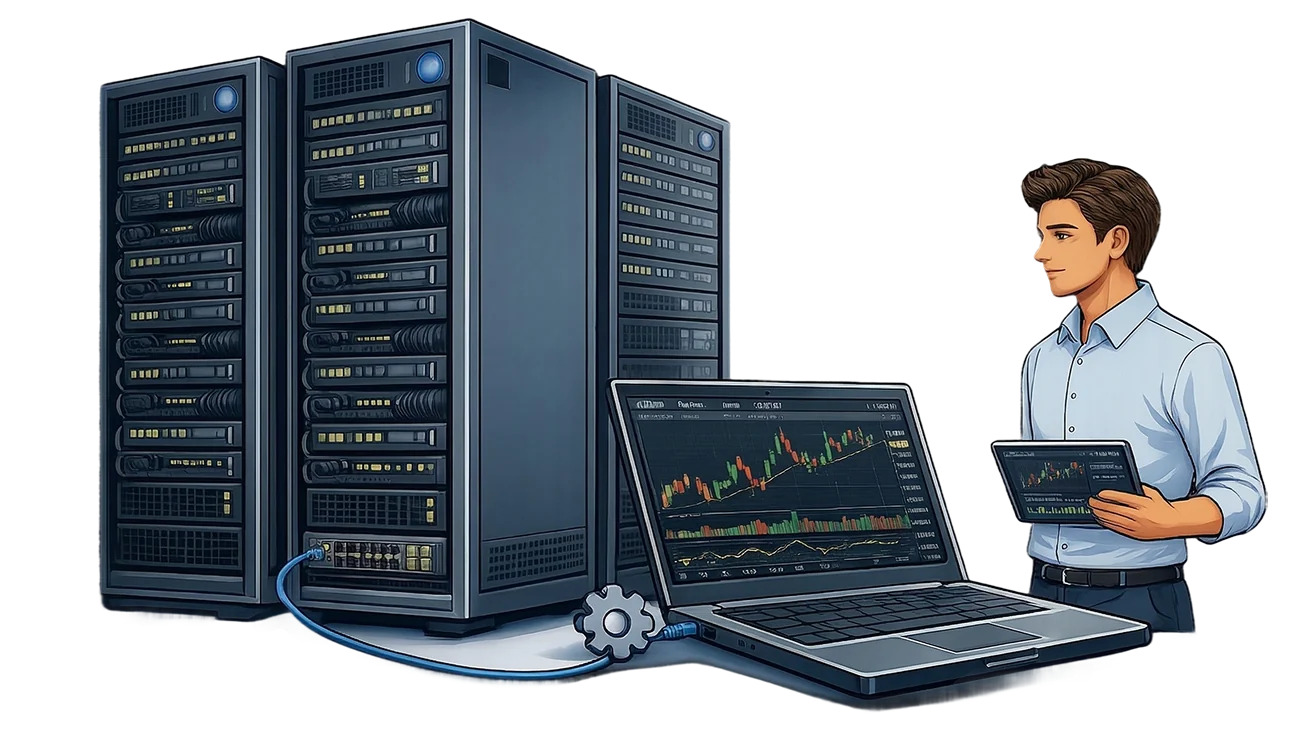
Global Trading Infrastructure
12 Data Centers Across 7 Financial Hubs
Latency starts with geography. Our infrastructure spans eight financial hubs, adjacent to major exchanges and broker systems. From Chicago, typical latency to CME is 0-1ms.
Exchange-Adjacent Server Locations

Chicago
United States | 2 Data Centers

New York
United States | 3 Data Centers

London
United Kingdom | 1 Data Center

Frankfurt
Germany | 1 Data Center

Singapore
Singapore | 1 Data Center

Tokyo
Japan | 1 Data Center

Dallas
United States | 1 Data Center

Hong Kong
Hong Kong SAR

Sydney

Included in all locations:
 Exchange-Adjacent Routing
 3-10 Gbps Network Capacity
 Redundant Network Paths
 Built-In DDoS Protection
 Windows Server 2025
Trading Network
Built Around The Route
See NetworkExchange-Adjacent By Design
A server cannot outrun geography. We place infrastructure near the exchanges, broker gateways, and financial data hubs traders actually connect to.
Blended Transit & BGP Routing
Multiple Tier-1 carriers, Border Gateway Protocol, and route diversity give market data, platform sessions, and order traffic cleaner paths, with alternatives when a carrier has a bad day.

99.99% Measured Uptime + 100% SLA
We publish measured uptime and back it with service credits under a 100% uptime SLA. A guarantee is useful. The operating record matters more.

3-10 Gbps Network Capacity
More capacity helps keep market data, remote sessions, platform updates, backfills, and copy traffic moving without competing through a narrow link.
Latency By Route
Typical Chicago-to-CME latency is 0-1ms. Other results depend on the exchange, broker, and carrier path, so we measure the route that matters instead of publishing one flattering global number.
Reliable Infrastructure
Security
See Every Security Layer
Controlled Physical Access
24/7 surveillance, biometric and badge access, mantraps, and staffed facilities keep physical access limited, logged, and reviewable.

Locked Cabinets & Dual Authorization
Server rooms require dual-authentication access. Locked cabinets, camera coverage, and controlled visitor procedures add another barrier around the hardware.

Firewalls + DDoS Protection
Hardware and software firewalls sit between the public internet and the server. Layer 3/4/7 DDoS mitigation is built into every plan to filter attack traffic before it reaches the trading environment.

Encrypted, Managed Access
AES-256 encryption protects RDP traffic in transit. Custom ports and firewall rules are configured by support at no extra cost, because secure defaults should not be an add-on.
Redundancy
Trading infrastructure has to absorb ordinary failures without turning them into your problem. We build multiple layers across power, network, storage, and cooling.

Redundant Power: UPS systems bridge short interruptions. Generators provide longer-duration backup when utility power fails.
Multiple Network Paths: Blended carriers and redundant routes keep one provider or path from becoming a single point of failure between your trading platform, broker, and market data.
Mirrored Storage: RAID 1 mirrors data across drives so a single disk failure does not take the server with it.
Cooling Built For Sustained Load: Liquid, air, and free-cooling systems are used where supported by the facility to keep hardware inside stable operating ranges under sustained demand.
Infrastructure Footprint
Always-on infrastructure has a physical footprint: power, cooling, hardware, and replacement cycles. We work with established facility operators and reduce waste where the decisions are ours.

Efficient Facilities: We prioritize operators investing in adaptive cooling, efficient power systems, and certified facilities. Standards vary by site, so we do not pretend every building is identical.
Energy Mix: We favor facilities with renewable-energy programs and lower-carbon operations, then use offsets where direct reductions are not yet available.
Hardware Sourcing & Lifecycle: We source through responsible suppliers and choose efficient components. Hardware leaves production once it no longer meets our performance and reliability standards, then moves to lower-demand uses or responsible recycling.


Put Your Server Closer To The Market
Choose the location nearest the exchange or broker your platform talks to. Then deploy the Alpha, Gamma, or Delta infrastructure your workload needs.
Find My PlanLocation Status