SOC 2® Type II Report Issued
Audited.
Continuously.
ChartVPS holds a SOC 2 Type II report. An independent auditor tested how our security controls operate over a three-month period, not just how they look on paper on a single day.
Audit information

- Review Period
- 3 months
- Period
- Jun 22 – Sep 22, 2026
- Report Date
- Oct 29, 2026
- In-Scope Controls
- 71
- Auditor
- Prescient Assurance
- Re-Audit Cycle
- Annual
Operational Controls
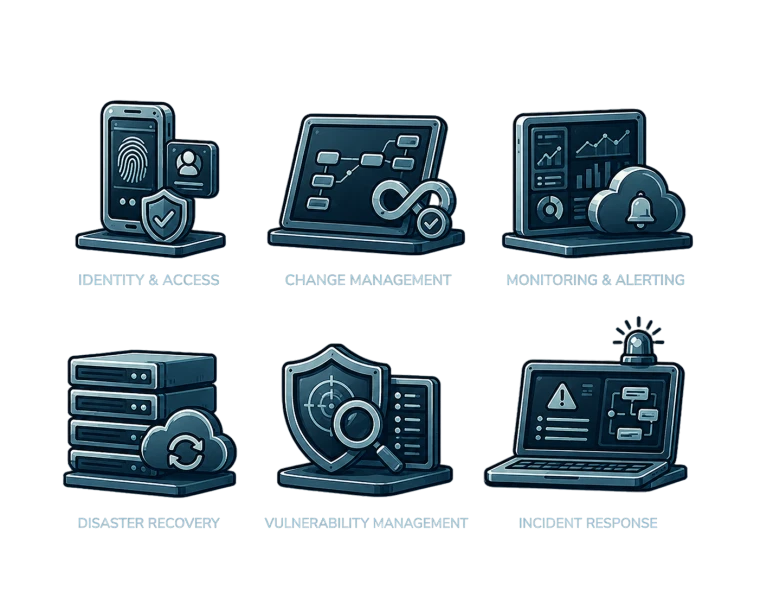
Identity & Access
SSO, MFA on all remote and admin access, least-privilege RBAC, quarterly access reviews.
Quarterly Access ReviewsChange Management
Every production change is documented, peer-reviewed, tested, and formally approved before deployment.
Auditable Change LogsLogging & Monitoring
Centralized audit logging with intrusion detection and file-integrity monitoring; alerts on anomalous or tampered logs.
Audit Logging + IDSDisaster Recovery
Documented recovery procedures with automated environment replication. DR plan tested at least annually.
Annual DR TestVulnerability Management
Vulnerability scanning at least annually plus periodic external scans, findings tracked to resolution, and regular penetration testing.
Regular Pen TestingIncident Response
Defined severity levels, incident notification timeframes, post-incident reviews shared on request.
Defined Response SLAThe difference between paperwork and proof.
Type I confirms controls exist. Type II confirms they work, day after day, for months. ChartVPS holds both.
SOC 2 Type I
Auditors verify that controls are designed correctly on a single point in time. A snapshot. Most VPS providers stop here.
- Point-in-time review
- Controls exist on paper
- Single audit window
SOC 2 Type II
Auditors observe whether controls actually function over a sustained window. Continuous evidence collection. The real validation.
- Operational over time
- Evidence tested across the full period
- Independent re-audit annually
ChartVPS vs Others
Where competitors fall short
| Criterion | ChartVPS | Generic VPS providers |
|---|---|---|
| SOC 2 Type I | Report issued | Often absent |
| SOC 2 Type II | Report issued | Often absent or Type I only |
| Trust criteria | Security · Availability · Confidentiality | Unscoped |
| Evidence window | 3-month review period (Jun 22 – Sep 22, 2026) | Snapshot only |
| Auditor | Prescient Assurance | Self-attestation or none |
| Customer-facing report | Type I and Type II reports under NDA via trust center | Marketing PDF, if any |
| Incident notification SLA | Defined · published | Best-effort |
| Access reviews | Quarterly, evidenced | Ad-hoc |
| DR testing | At least annual, results logged | Untested |
| Encryption policy | AES-256 at rest, TLS 1.2/1.3 in transit | Varies per node |
Trust, demonstrated — not described
Request our SOC 2 Type II report or talk to our security team.