

Think about what you leave running when you step away from the desk: a strategy following the overnight session, several chart workspaces, or an optimization testing tomorrow’s ideas.
You expect the data in memory to remain intact as the software works with it. ECC gives the hardware a way to check that assumption.
When it does its job, a covered memory error gets corrected while your platform or research process carries on. There may be nothing on screen to tell you anything happened.1
That is less exciting than another CPU benchmark. But if you have spent hours building a workspace or waiting for a research run, protecting the work already under way deserves some attention too.
ECC means error-correcting code. In memory, it adds a way to detect certain changes to stored data and, within its capabilities, reconstruct the correct bits.1
The important phrase is within its capabilities. ECC does not validate a trading strategy, fix every crash, or make a server incapable of losing data. Understanding where the protection starts and stops is more useful than simply finding those three letters on a specification sheet.

Your Trading Session Lives In RAM
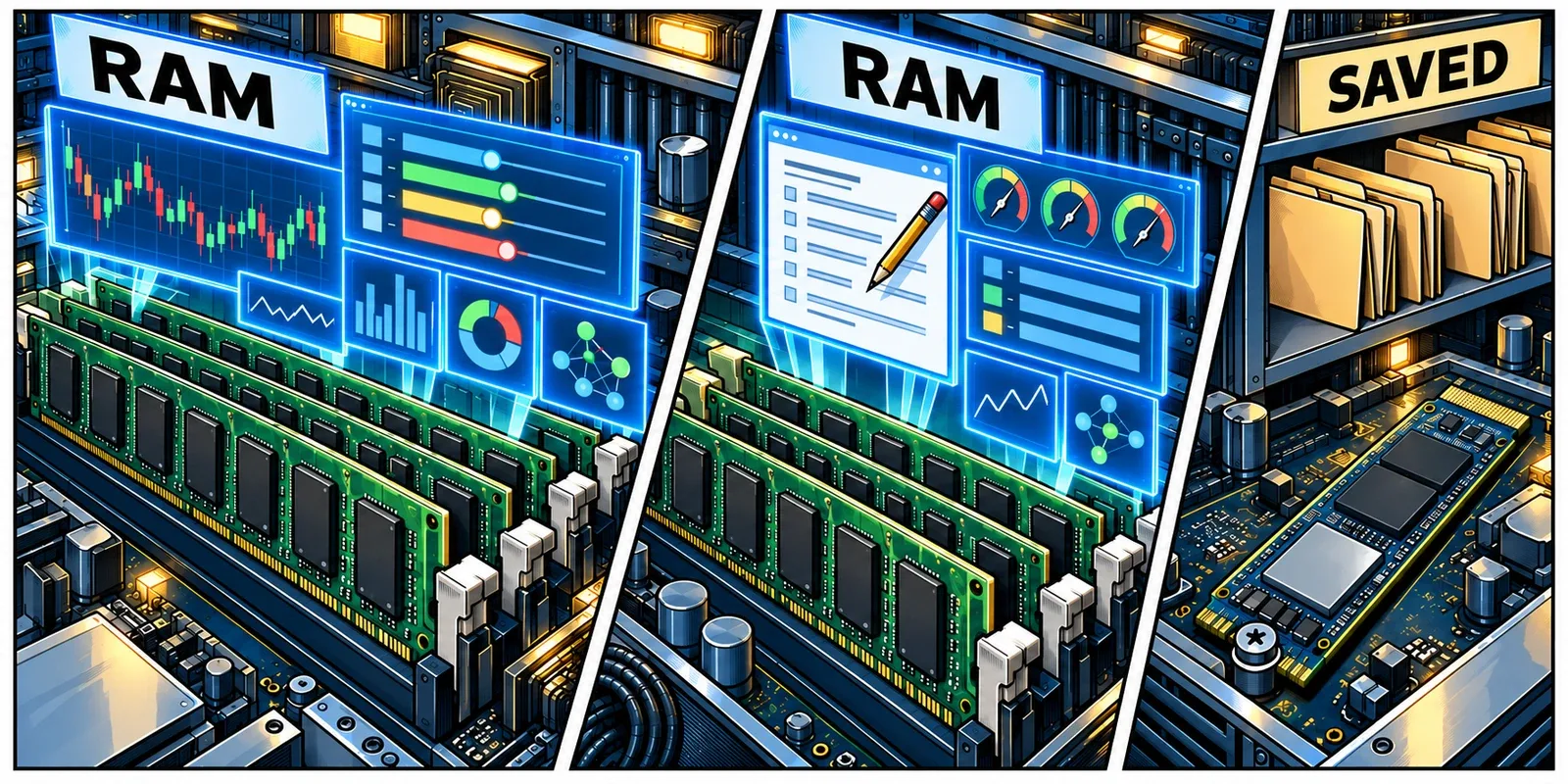
The files on your NVMe drive are the saved material. RAM is the working space.
Open NinjaTrader, load a workspace, and start processing market data. Indicators maintain calculated values. A NinjaScript keeps the variables it uses to evaluate the next tick. An optimization holds intermediate results while it works through parameter combinations. Much of that working state may never have been written to a file.
This is why memory integrity matters beyond whether Windows stays open. A process can keep running while working with a value that has changed underneath it. Depending on what changed, a hardware memory error might have no visible effect, interrupt a process, or corrupt useful data. There is no universal symptom that announces, politely, that RAM was responsible.
A bit flip is a change from a zero to a one, or the reverse. That sounds small because it is. Its significance depends on where it lands, not how dramatic it looks.
Some errors are transient disturbances. Others reflect persistent hardware faults and can recur. Large-scale research has found that persistent faults deserve serious attention, rather than treating every memory error as an isolated random event.2
For a trader running a brief manual session, recovering a workspace may be an inconvenience. For an unattended strategy or an optimization that has been running overnight, preserving the work in progress carries a different weight. That difference in workload is a good reason to care about ECC. It is not evidence that every non-ECC computer is about to fail.
What ECC Can Correct And Detect
ECC stores additional check information alongside the data it protects. When the data is read, the checking logic can identify certain inconsistencies and recover the intended value.1
It is not keeping a second complete copy of your trading platform. The extra information is calculated from groups of bits.
A common scheme is SECDED: single-error correction, double-error detection. Within one protected group, called a codeword, it can correct a single-bit error and detect a two-bit error without being able to correct that pair.3
| Error Pattern Within One Protected Group | Common SECDED Behaviour |
|---|---|
| One changed bit | Correct the bit |
| Two changed bits | Detect the error, but cannot reconstruct the original data |
| More complex corruption | Outside that guarantee; may be uncorrectable or escape reliable detection |
This is not a limit of one correction per computer, per day, or per memory module. Independent single-bit errors in separate codewords can each be corrected. Stronger protection schemes also exist, so the exact capability depends on the implementation.13
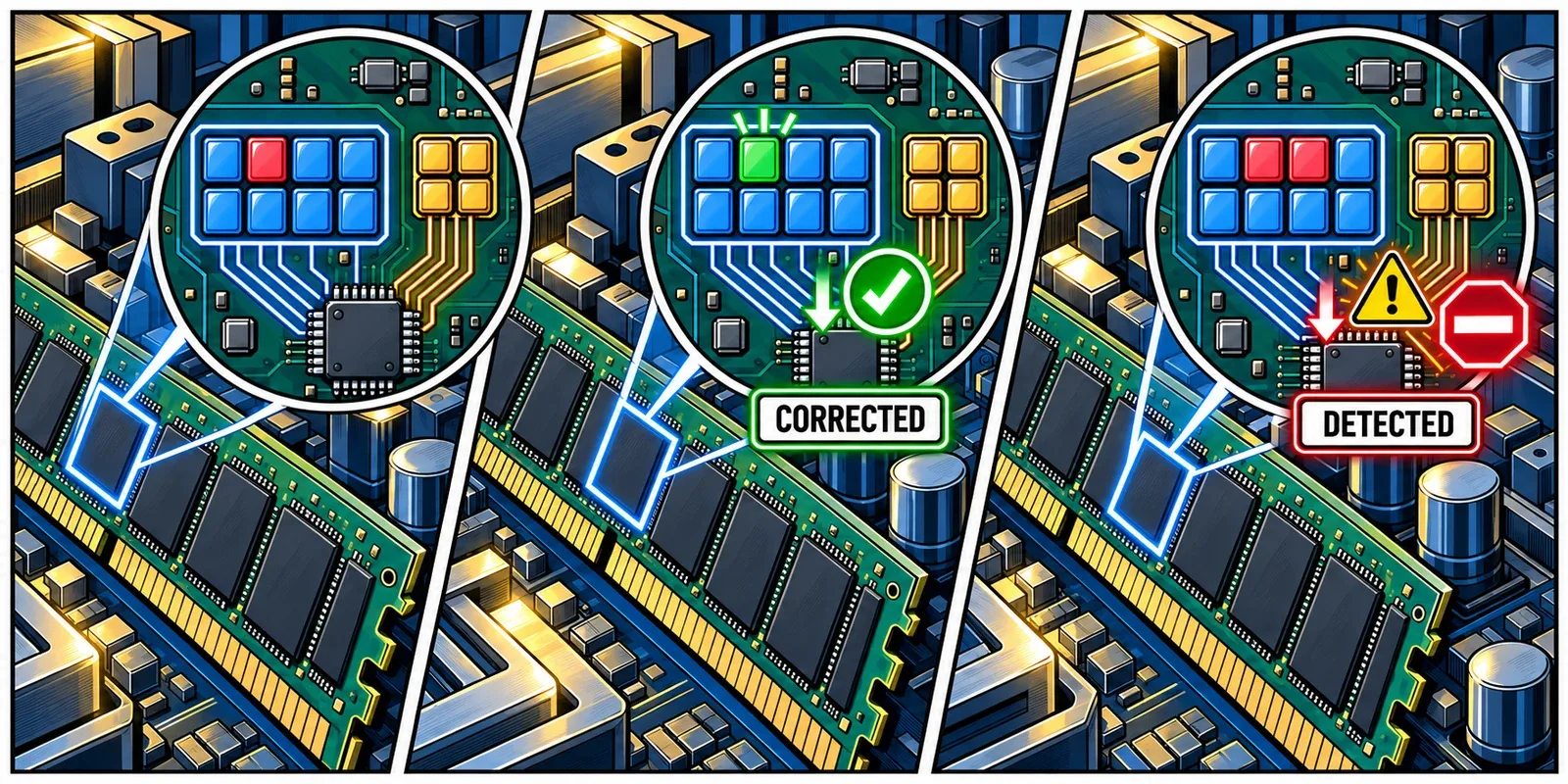
When hardware corrects an error successfully, the application can continue without handling it itself. A detected but uncorrectable error is a different situation. Depending on the hardware, operating system, and affected memory, recovery may be possible or the system may need to stop. Microsoft’s hardware-error model explicitly distinguishes corrected, recoverable, and fatal errors.4
Detection still has value. Refusing to continue with known-bad data can be safer than silently using it. But calling that event uninterrupted operation would be a stretch.
Think of a historical-data array being read during an optimization. If a covered bit error affects that data, correction can restore it before the calculation uses it. The same protection applies to the memory holding a live platform’s state. That is the trading benefit: preserving the data the software is working with, not judging whether the strategy itself is sound.
DDR5 On-Die ECC Is A Different Layer
There is a detail in DDR5 specifications that causes understandable confusion: DDR5 has on-die ECC.
The die is the silicon inside a memory chip. On-die ECC corrects errors within that chip. It is useful, but it does not provide the same protection as a system using ECC memory modules and an ECC-capable memory controller. In particular, it does not correct errors on the bus between the module and the processor’s memory controller.5
System-level ECC uses additional check bits and controller support to protect a broader part of that memory path. An ECC DDR5 module can have both layers. Ordinary DDR5 having the first does not mean it has the second.5
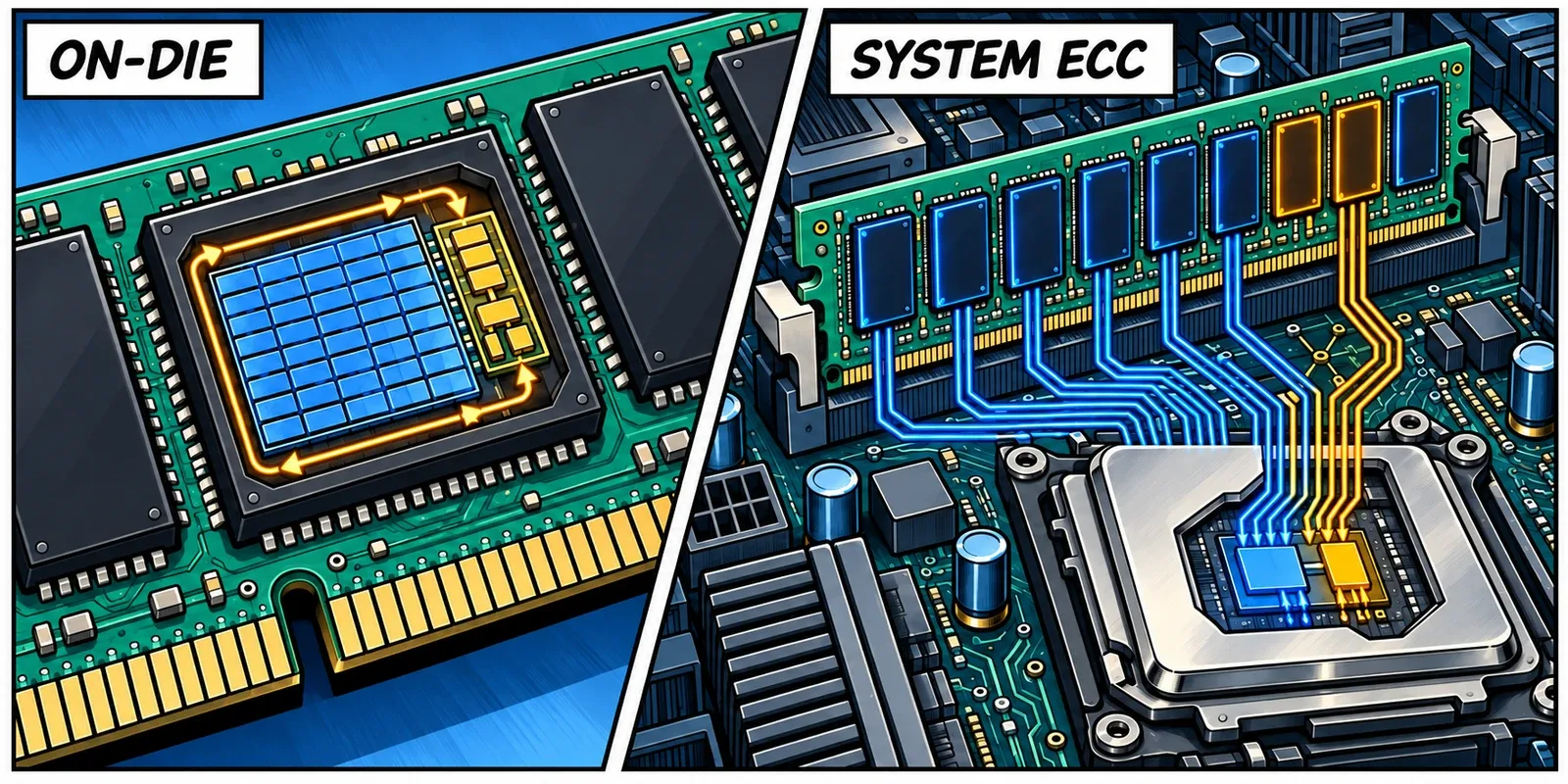
The useful buying question is therefore: does this system provide memory-controller ECC with suitable ECC modules, or only DDR5’s internal on-die correction?
That is a fair question for a workstation builder or VPS provider. You do not need to debate memory architecture with sales. You need an answer that distinguishes two different capabilities instead of treating the word DDR5 as sufficient proof of both.
What ECC Does Not Fix
Suppose a data feed delivers an incorrect price and your software stores it in memory. ECC can preserve that incorrect price perfectly.
The bits are intact. The input is wrong.
The same applies to a NinjaScript that calculates the wrong position size, an indicator using the wrong session template, or a backtest built from incomplete historical data. These are problems with meaning, configuration, or logic. Memory correction has no knowledge of any of them.
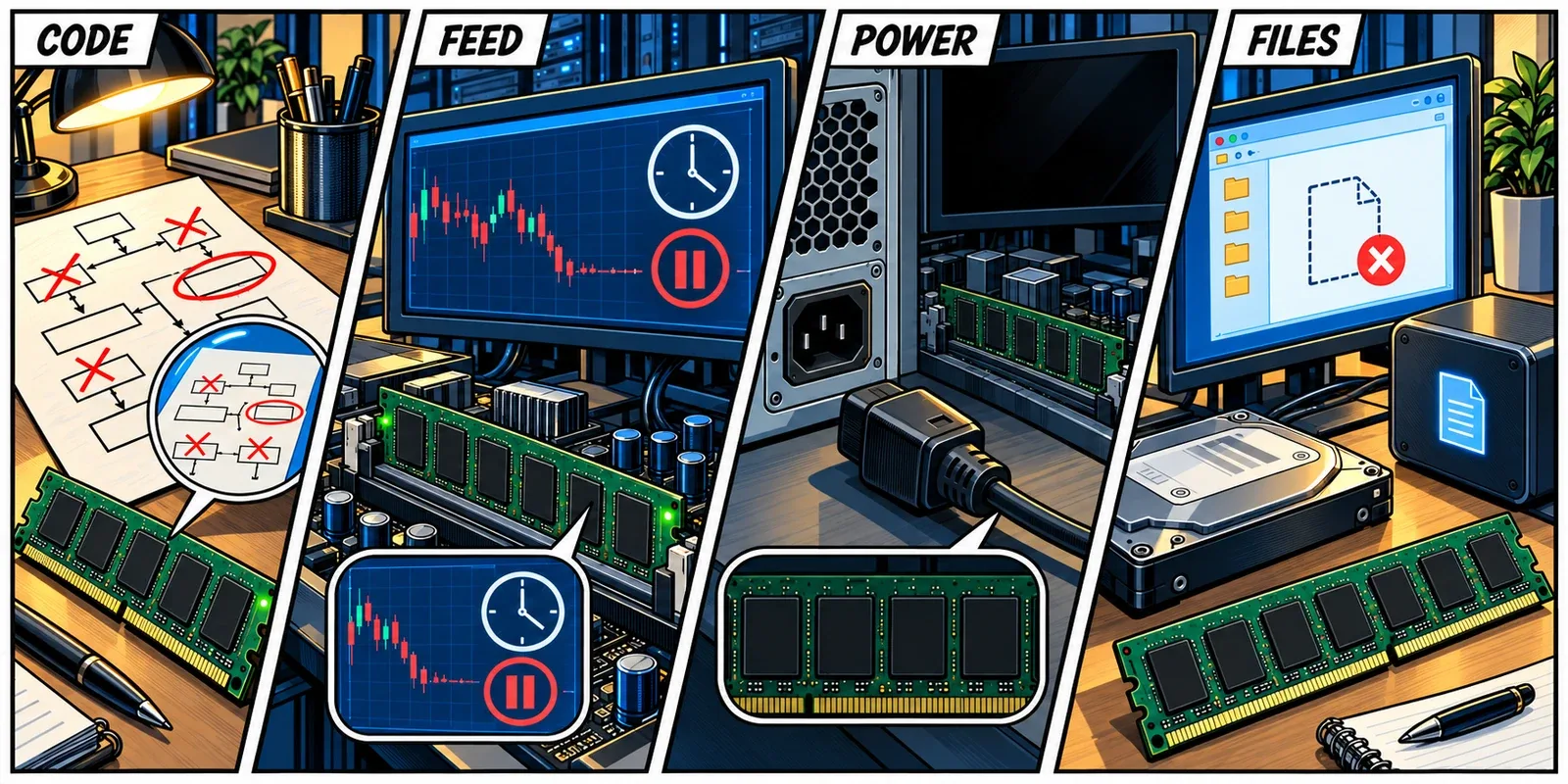
Keep these boundaries in mind:
- Insufficient RAM: ECC does not create more capacity. An oversized workspace can still run into memory pressure.
- Software bugs: a program can write an incorrect value and generate perfectly valid check bits for it.
- Power loss: ECC RAM is still volatile memory. Correction does not turn it into persistent storage.
- Deleted or damaged files: memory ECC is not a previous version of your templates, scripts, or database.
- Every possible corruption pattern: an ECC scheme has a defined correction capability, not unlimited repair power.
That is why reliable trading infrastructure needs several separate measures. Input checks address bad data. Software testing addresses logic. Backups provide recovery. Power resilience reduces interruptions. ECC addresses a particular hardware integrity problem.
Consider an overnight research run. ECC may correct a covered bit error while the process continues. It cannot recover the whole unsaved run after a power failure, nor can it notice that the test used the wrong commission assumptions. Those distinctions are worth making before the word protected becomes too comfortable.
A Corrected Error Still Deserves Attention
Correction is good news. Repeated correction from the same piece of hardware is a reason to investigate.
An ECC mechanism can reconstruct data without repairing the physical fault that caused the problem. The operator needs to know whether an event was isolated or part of a developing pattern.
Linux’s EDAC reporting can expose corrected and uncorrected errors and their hardware locations, where supported. Windows uses its hardware-error reporting framework, WHEA. What gets surfaced depends on the hardware, firmware, and reporting configuration; a quiet application is not a complete hardware health report.36

Some platforms also support memory scrubbing. A background hardware process reads memory, checks it, and corrects covered errors. This can find problems in data that applications have not recently accessed and reduce the opportunity for errors to accumulate.7
Scrubbing is not a replacement for replacing faulty hardware. Nor should a provider choose an arbitrary error-count threshold and assume every machine below it is healthy. Useful investigation considers recurrence, location, timing, hardware guidance, and whether uncorrectable events have occurred.
A well-known Google field study found persistent hardware faults played a substantial role in observed DRAM errors.2 It was published in 2009. It supports taking recurring faults seriously; it does not tell us the annual failure probability of a particular DDR5 VPS in 2026.
For an unattended trading strategy, this makes the provider’s response important. Repeated corrections deserve investigation even if the platform still looks normal. Ask who reviews those events and how maintenance or recovery would be coordinated around an active session. An ECC module plus ignored logs is an incomplete operational policy.
What Your Charts, Backtests And Algos Need From RAM
It is tempting to read “ECC DDR5” as one performance feature. It describes two different things.
DDR5 is the memory generation, with its own transfer capabilities and architecture. ECC describes error protection. DDR5’s bandwidth improvements do not come from correcting bits, and enabling ECC does not automatically make a backtest finish sooner.8
For a trading workload, separate the questions:
| Question | What It Means At The Trading Desk |
|---|---|
| How much memory is available? | Can the platform, histories, indicators, and research jobs fit without excessive paging? |
| How quickly can the system access it? | Can memory supply the CPU’s workload efficiently, given bandwidth, latency, channels, and configuration? |
| How is its integrity protected? | Can the hardware detect and correct covered memory errors? |
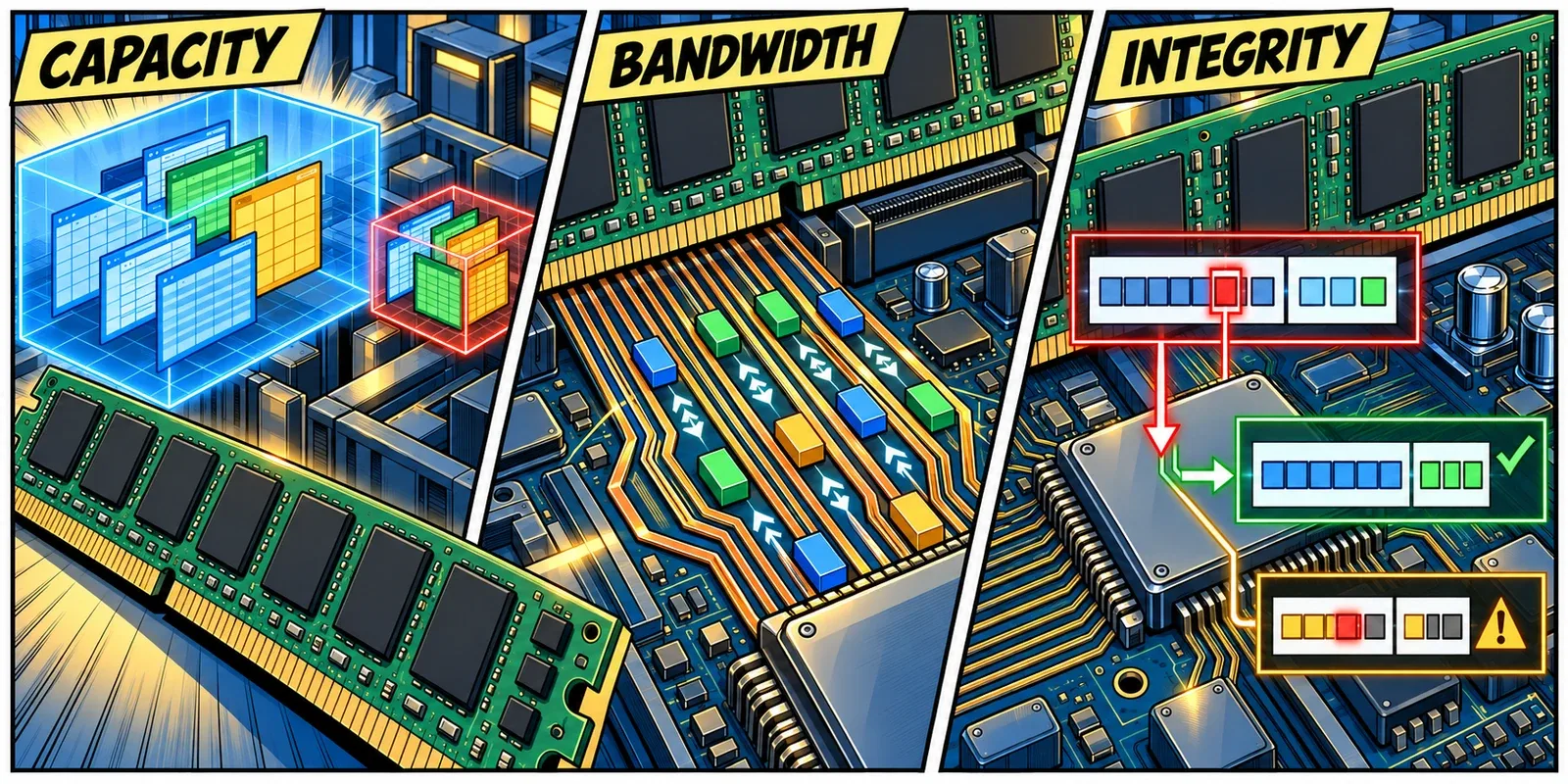
If a large historical dataset does not fit comfortably, buying less memory because it carries an ECC label is not a sensible trade. Equally, a high transfer rate does not answer the integrity question.
There is no useful universal claim that ECC makes every application a fixed percentage slower. Compare supported configurations using the same platform workload, not an isolated label. CPU behaviour, memory settings, module population, and the work being measured all belong in the comparison.
For an optimization, measure repeatable completion time. For a live workspace, watch responsiveness and memory pressure through the conditions that normally stretch it. Treat hardware integrity as a separate requirement. A benchmark can show how fast a job finished; it cannot, by itself, establish that the machine has appropriate error protection.
The Whole Platform Has To Support It
Installing an ECC-labelled memory stick is not the whole job.
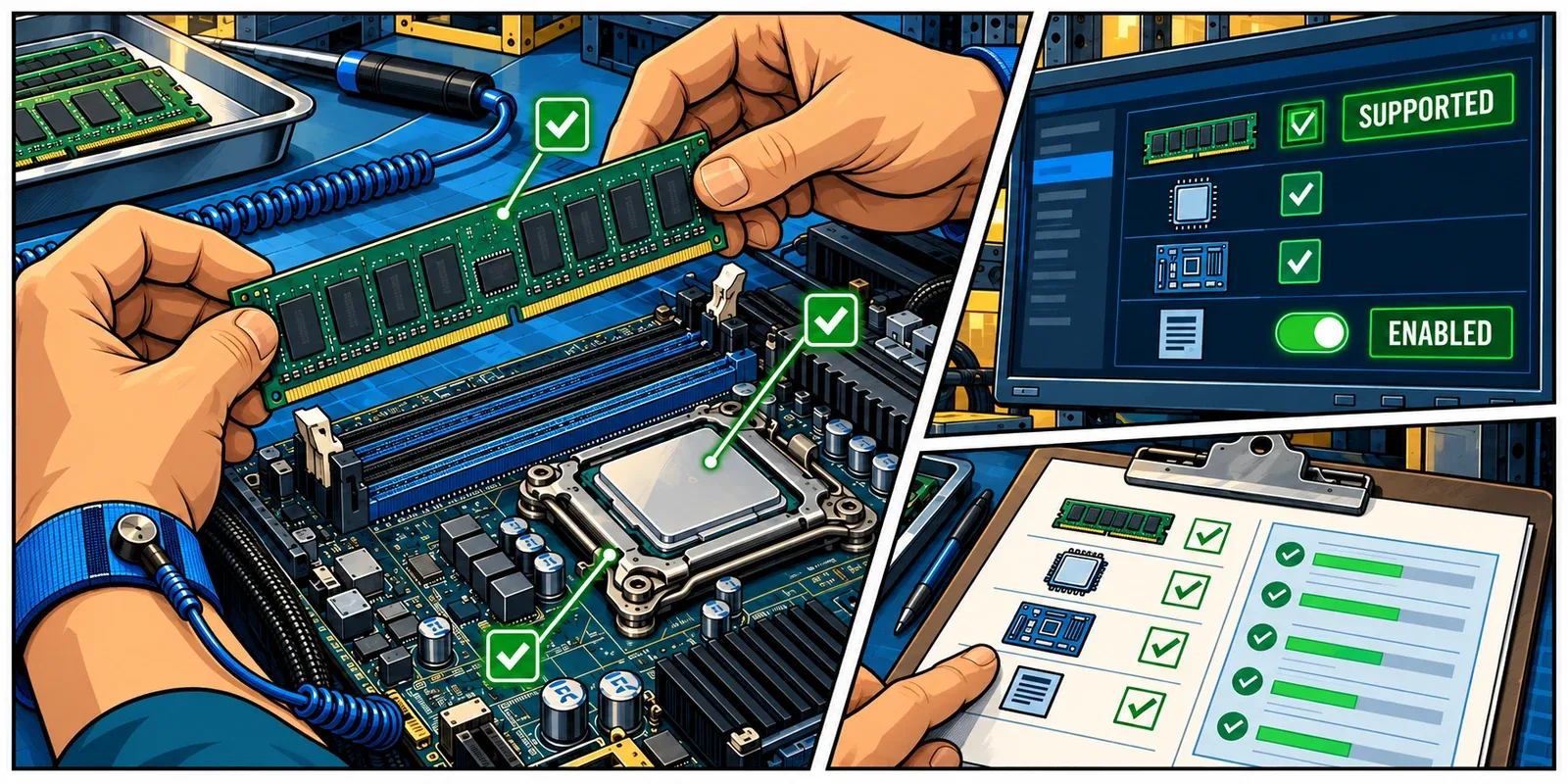
The processor’s memory controller, motherboard, module type, and firmware need to support the configuration. Correction must actually be enabled and supported, rather than assumed from a product name.
AMD’s Ryzen 9 9950X specification, for example, lists ECC support but explicitly requires motherboard support.9 That makes ECC possible on an appropriate Ryzen platform. It does not mean every 9950X desktop automatically provides it.
Another distinction: ECC is not a synonym for registered memory. Registration changes how a module handles certain signals. ECC concerns error correction. Unbuffered ECC modules exist, and module compatibility matters. DDR5 registered and unbuffered modules are not interchangeable upgrades.10
Extra memory components for check information contribute to ECC module cost.1 A properly supported system also requires compatible components and validation. That is a better explanation of its value than treating a higher price as proof that it is better at everything.
If you are building locally, check the CPU and motherboard documentation, supported module list, and available error reporting. If you are renting infrastructure, ask the provider to confirm the configuration on the physical host.
Neither exercise requires becoming a memory engineer. It means verifying the feature you intended to buy is present and operating, rather than inferring it from the processor brand or the word server.
What To Ask Your Trading VPS Provider
Inside a VPS, Task Manager can show how much memory Windows sees and uses. That is not an ECC health report for the physical host.
The provider normally has the relevant view of the underlying memory hardware. A customer-facing usage graph and host-level hardware-error evidence answer different questions.

Ask a few direct questions:
- Does the physical host use system-level ECC, rather than only DDR5 on-die ECC?
- Is the installed combination of processor, motherboard, memory, and firmware supported and operating with correction enabled?
- Can the operator inspect corrected and uncorrectable memory events?
- What happens when errors recur on a module or host?
- What recovery arrangements exist for problems ECC cannot repair?
These questions reveal more than asking whether the RAM is “enterprise-grade”. You are looking for a specific capability and a practical response when the hardware starts asking for attention.
If your platform is crashing, avoid diagnosing RAM from the crash alone. Record the time, affected process, recent changes, and available application logs. Ask support to correlate those observations with host events. ECC belongs in that investigation, not at the end of every unexplained symptom.

A Practical Example: ChartVPS
ChartVPS uses ECC DDR5 in its trading infrastructure. DDR5 provides the memory platform; ECC adds protection against covered hardware memory errors. For a long-running trading workspace, that is a useful reliability layer alongside monitoring and recovery, rather than a claim of faster fills or error-free software.
The broader buying principle applies to any provider: understand what is protected, verify that the protection is active, and find out who responds when it reports a problem.
ECC is valuable precisely because its job is narrow and concrete. It gives certain hardware errors a chance to be corrected before your trading platform has to live with the result.
Related Reading
- Why Single-Thread Performance Still Matters in Trading
- Dedicated CPU vs Shared vCPU: What Your Trading Platform Actually Gets
- ChartVPS Technology
- Backups And Recovery
Sources
- Kingston Technology, What Is ECC in Memory and SSD? Why It Matters for Servers and Enterprise Systems. ↩ ↩ ↩ ↩ ↩
- Bianca Schroeder, Eduardo Pinheiro and Wolf-Dietrich Weber, DRAM Errors in the Wild: A Large-Scale Field Study, SIGMETRICS, 2009. Historical field research, not a forecast of current DDR5 error rates. ↩ ↩
- Linux Kernel Documentation, Error Detection And Correction Devices. ↩ ↩ ↩
- Microsoft Learn, Hardware Errors and Error Sources. ↩
- Kingston Technology, DDR5 Memory Standard: An Introduction, particularly the on-die ECC discussion. ↩ ↩
- Microsoft Learn, Error Processing. ↩
- Intel, Reliability, Availability, and Serviceability, the Patrol Scrub section on the long-standing volatile-memory mechanism. ↩
- Kingston Technology, Why DDR5 Memory Is Important for Data Center Performance and Efficiency. ↩
- AMD, Ryzen 9 9950X Specifications, ECC support requires motherboard support. ↩
- Kingston Technology, Server Memory Technical Support. ↩